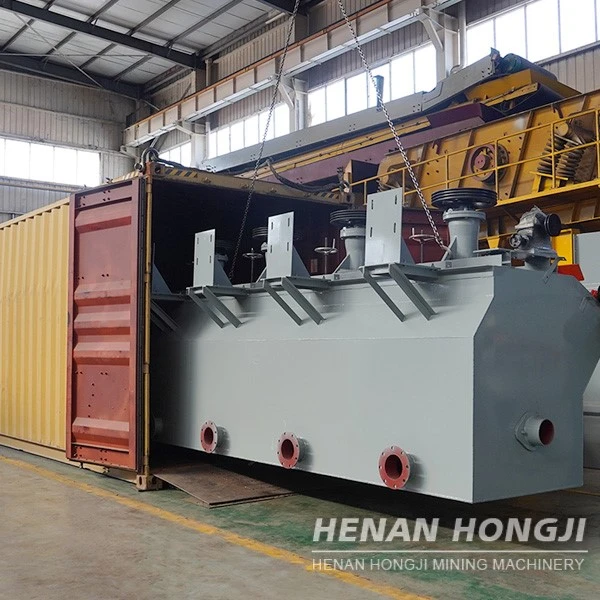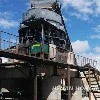

Key equipment includes:
1. Crushing equipment: crushers, belt conveyors, ore feeders, and sometimes screening equipment;
2. Grinding equipment: ore feeders, belt conveyors, ball mills or rod mills, spiral classifiers or hydrocyclones, slurry pumps, etc.;
3. Flotation equipment: typically flotation machines, though flotation columns are sometimes used;
4. Concentrate thickening and filtration equipment: generally thickeners, filters, etc., often supplemented by slurry pumps;
5. Water supply equipment: water pumps, elevated water tanks, etc.;
6. Tailings transport and storage: tailings pumps and pipelines, tailings storage facilities (tailings dams), reclaimed water recovery systems, etc.;
7. Maintenance equipment: varies depending on specific requirements.
Copper Ore Beneficiation Process:
For disseminated copper ores, a relatively simple flotation process is typically employed: single-stage grinding (achieving a fineness of 50%–70% passing 200 mesh), followed by one roughing stage, two to three cleaning stages, and one to two scavenging stages. If the copper minerals are finely disseminated, a staged grinding-flotation process may be considered. Plants processing bornite-bearing ores often utilize a "regrinding of rougher concentrate followed by cleaning" approach-a staged process that is essentially a combined bulk-selective flotation scheme. The ore undergoes initial coarse grinding, roughing, and scavenging; the resulting rougher concentrate is then reground and subjected to further cleaning to produce high-grade copper concentrate and sulfur concentrate. In this process, the initial coarse grinding typically achieves a fineness of 45%–50% passing 200 mesh, while the regrinding stage achieves 90%–95% passing 200 mesh.
In the case of massive (dense) copper ores, chalcopyrite and pyrite are intimately associated. Pyrite is frequently activated by secondary copper minerals; furthermore, due to its high content, the pyrite is difficult to depress, making the separation process particularly challenging. The beneficiation process requires the simultaneous production of a copper concentrate and a sulfur concentrate. Typically, the tailings remaining after copper flotation serve as the sulfur concentrate; however, if the gangue content in the ore exceeds 20%–25%, further processing is necessary to obtain a sulfur concentrate. When treating massive (dense) copper ores, a two-stage or staged grinding process is commonly employed, requiring a relatively fine grind. Reagent consumption is also high: xanthate dosage typically exceeds 100 g per tonne of raw ore, while lime usage is 8–10 kg or more per tonne of raw ore.