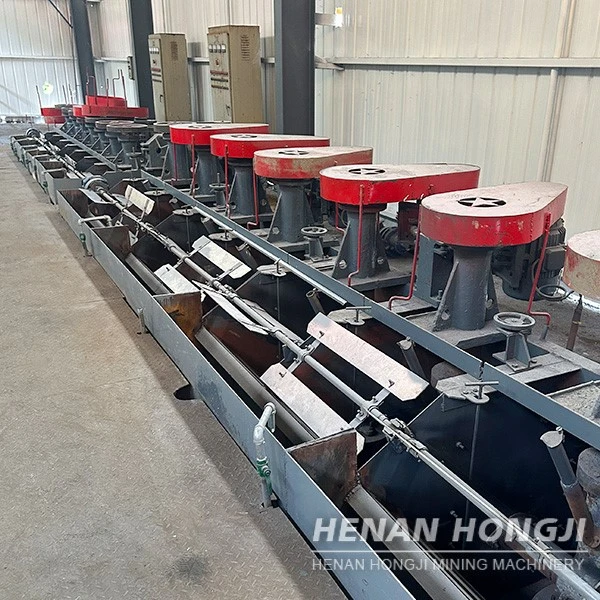

The rotational speed of a copper ore flotation machine requires dynamic adjustment. It is generally recommended to maintain a speed of no less than 764.92 rpm, though for certain models or specific operational scenarios, this may be increased to over 2400 rpm.
1. Flotation Machine Type and Design
Factory-preset rotational speeds vary significantly by model; please refer to the specific equipment parameters:
• XFD1 flotation cell: Impeller speed is 2590 rpm or 2340 rpm.
• XFD1.5 flotation cell: Impeller speed is 2100 rpm or 1900 rpm.
• XFD3 flotation cell: Impeller speed is 1910 rpm or 1750 rpm.
• XFD8 flotation cell: Impeller speed is adjustable across three settings: 1890 rpm, 1708 rpm, and 1400 rpm.
2. Adaptation to Mineral Characteristics
High rotational speeds are generally well-suited for the flotation of metallic ores. For instance, when processing sulfide ores, increasing the speed to 2400 rpm can achieve an optimal dynamic balance between bubble distribution and mineral flotation (upward transport). Rotational speed adjustments should be aligned with mineral properties such as density and particle size.
3. Three Principles for Process Control
- The speed must exceed the critical threshold of 764.92 rpm to ensure that solid particles remain fully suspended.
- Maintain an appropriate level of agitation intensity-sufficient to ensure thorough contact between mineral particles and bubbles, while avoiding excessive turbulence (often described as "boiling" or "splashing" on the pulp surface).
- In industrial production, it is generally preferable to operate at the higher end of the speed range. Monitoring via external recording instruments typically shows a 3–5% increase in recovery for every 200 rpm increment; these data can be used to continuously optimize operating parameters.
In practice, it is recommended to consult the equipment's nameplate specifications, test the suspension state of the pulp at a baseline speed, and then gradually increase the speed in increments of 50–100 rpm-while simultaneously observing changes in the thickness of the flotation froth layer and the grade of the concentrate.